How Octo teaches.

Start with something familiar. Build one idea on the next. Put what you learn to use.

Try a lesson example

Same topic.
A lesson that meets you where you are.

Change the topic. Change the learner. See how the teaching changes.

The concept

A general explanation

How language models generate text

A language model learns patterns from training data. Given a sequence of tokens, it predicts a distribution over possible next tokens and generates text step by step. A fluent response is not a guarantee of accuracy.

  1. 01Training data
  2. 02Token prediction
  3. 03Generated output
Learning with Octo

4 years in content & campaigns

Learning goal: Turn creative work into measurable growth

A brilliant draft. An invented claim.

You ask AI for a launch email. It writes ‘our best-selling product’; but you never gave it sales figures. It learned how launch copy sounds, not whether your product is a bestseller. Give it verified facts, then check the draft.

Picture the idea

Your product brief

AI predicts the next words

You verify the claims

Your brief shapes the draft. Evidence determines what you can publish.
The draft says ‘twice as fast.’ What do you check?

Find a measured comparison that supports the claim. If there is no evidence, remove it. Confident wording is not a source.

Next in your path · Write a grounded campaign brief
Illustrative lessons and learner profiles. Your course starts with your own story.

The method behind the lesson

Follow one example: learning to use AI for a campaign brief.

  1. 1

    Start with a familiar situation

    Introduce the idea through a problem you recognize.

    See an example

    Writing with AI

    The concept

    A language model generates text from patterns learned during training.

    In the lesson

    Your AI draft calls a new product a bestseller. You never supplied sales figures. Where did the claim come from?

  2. 2

    Connect the new to the known

    Use a simple mental model, then explain its limits.

    See an example

    A useful mental model

    The concept

    Fluent output does not guarantee factual accuracy.

    In the lesson

    Treat the draft like copy from a writer who knows the style but has not checked your facts. The model is generating text, not independently verifying your product.

  3. 3

    Try the idea yourself

    Apply the idea before moving on.

    See an example

    Improve the brief

    The concept

    Specific context helps shape a useful response.

    In the lesson

    Replace ‘write a launch email’ with a brief that names your audience, the product facts, and the action you want readers to take.

  4. 4

    Check what you understood

    Use a question to uncover a common misunderstanding.

    See an example

    Check the claim

    The concept

    Review generated content before using it.

    In the lesson

    Your draft says ‘twice as fast.’ Is confident wording enough? Find the measurement that supports it. If none exists, remove the claim.

  5. 5

    Make the idea visible

    Show relationships that are harder to follow in prose.

    See an example

    See the workflow

    The concept

    Provide context, generate a response, and review the result.

    In the lesson

    Your verified facts → AI draft → Your review. Each step has a job: supply evidence, propose wording, then check what you publish.

Your experience shapes the path

The topic stays the same. Your starting point, examples, and pace can change.

  1. 1

    Share your starting point

    Tell Octo what you know and what you want to do.

    Alex knows marketing but is new to AI.

  2. 2

    Review your course

    Refine the proposed lessons before you start.

    Begin with how AI works, then practice writing a brief.

  3. 3

    Build on each lesson

    Ask questions and review suggested changes as you learn.

    A question about invented claims can lead to a worked example.

Ask where you get stuck

Select a passage and ask Octo to explain it another way.

  • Stay with the lesson

    Ask about the exact idea you are reading.

  • Make it concrete

    Request an example that connects to your work.

  • Shape what comes next

    Review a suggested lesson update or addition before applying it.

Lesson · Review the claims in your draft

Before publishing, check each product claim against your evidence. A fluent sentence can still be wrong.

Ask Octo

What counts as evidence for ‘twice as fast’?

A measured comparison that names what was tested and under which conditions. If you do not have that, remove the claim or use a fact you can support.

Example answer about the selected passage

Illustration of a question beside the lesson.

Same physics.
A different way to learn.

A familiar situation gives an abstract equation something to stand on.

A conventional lesson

Physics · Newton’s second law

Force, mass, and acceleration

An object’s acceleration is directly proportional to the net force acting on it and inversely proportional to its mass.

F = ma

A net force of 10 N acting on a 5 kg object produces an acceleration of 2 m/s².

Learning with Octo

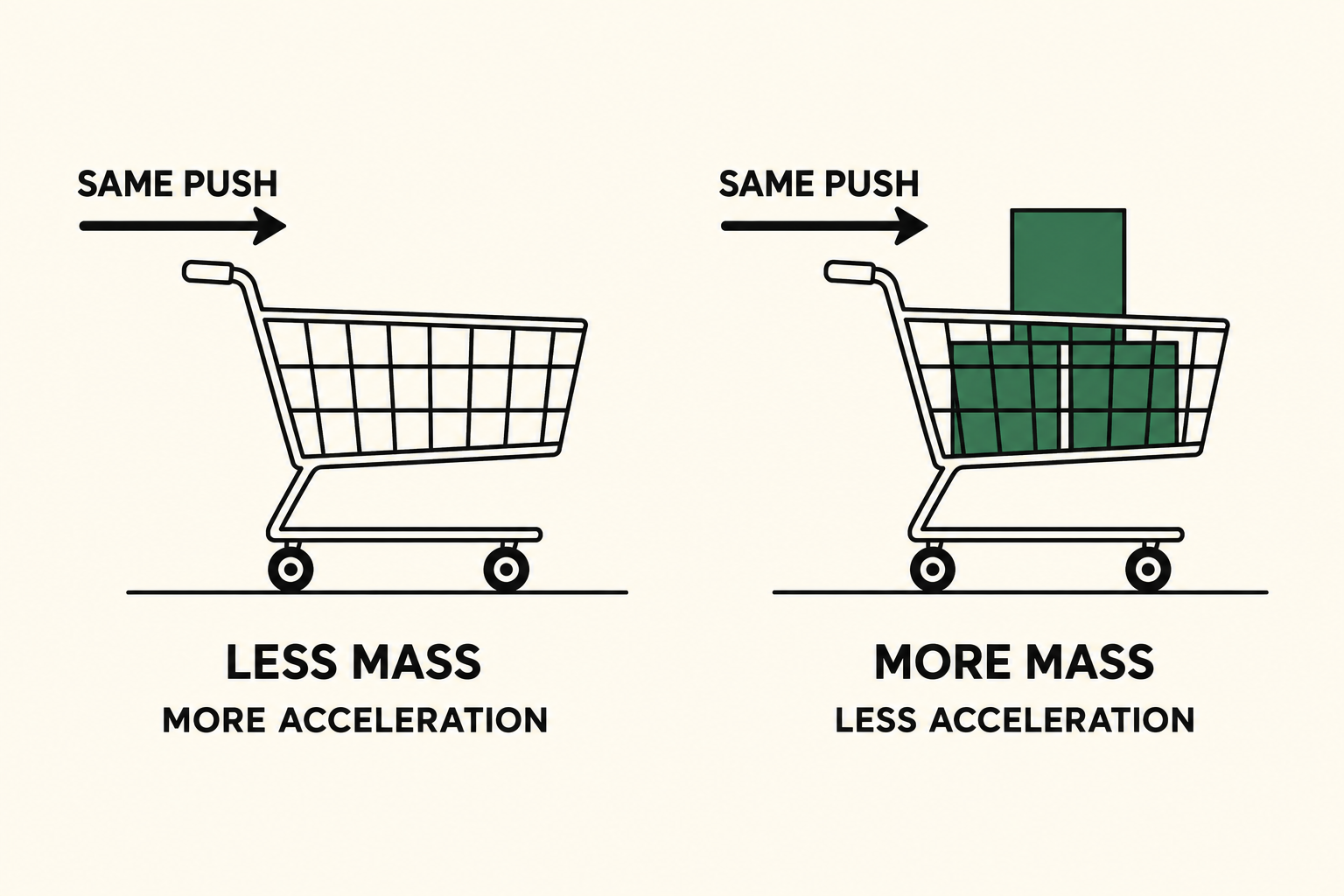
Why is a full cart harder to get moving?

Give an empty cart and a loaded cart the same push. The lighter one picks up speed faster. That’s a = F ÷ m in everyday life.

With the same net push, an empty shopping cart has less mass and more acceleration; a loaded cart has more mass and less acceleration.
Same net force. Ignore rolling resistance in this example.
Twice the total mass. Same push. What happens?

Acceleration halves. With the same net force, twice the total mass means half the acceleration: a = F ÷ m.

Illustrative lesson excerpts on the same concept.

See it. Try it. Explain it.

The format follows the idea, from a picture to a practical question.

  • See it

    Pictures and diagrams show how the pieces connect.

  • Try it

    Work through an example before reading the answer.

  • Go deeper

    Ask a follow-up question or check a source.

Finish with proof of completion

Share a public record of the course you completed.

  • Make it yours

    Complete the course and confirm the name on your certificate.

  • Share the link

    Anyone can check the name, course, and issue date without an account.

Sample completion record

Example

Awarded to

Alex Morgan

For completing

Learning AI: From Basics to Practice

Personal course · 3 chapters

learnatocto.com/verify/{your-id}

Chapters completed

  • Understand how AI worksCompleted
  • Get useful answers from AICompleted
  • Put AI to work responsiblyCompleted
Illustration only. An issued certificate has its own verification link.

Common questions

Why not just ask ChatGPT?

Octo brings your learning into one course: a plan you review, personal lessons, practice, and a tutor beside the page. Your progress is saved so you can return to it.

Is it free?

Yes, for your first 30 days: build as many courses as you like, with no card, and keep every one. After that, the conversation and curriculum are still free. You see the price before asking Octo to write another course’s lessons. There is no subscription.

How long does a course take?

It depends on your goal and starting point. Share your available time, review the proposed course, and work through it at your own pace.

Can I trust what it teaches?

Octo is in research preview and can make mistakes. Use its sources to check important claims, and tell us when something is wrong.

What does Octo remember about me?

Relevant context from your conversations can help personalize future lessons. You can review, delete, or pause memories in your profile.

Are the certificates real?

Issued certificates have a public verification link. They record completion of your Octo course, not a qualification from an exam body or university.

Start with your goal.

30 days free, no card required.